On November 30, according to the official account of "China Communications First Highway Engineering Group," the "underwater connection section" of the Jiangyin-Jingjiang Yangtze River Tunnel, constructed by the Tunnel Bureau of China Communications First Highway Engineering Group, was officially completed on November 29. This marks the full completion of the tunnel's main structure. The project team successfully solved the world-class challenge of shield tunneling "underwater connection" in high water pressure and highly permeable strata, representing a historic breakthrough in China's tunnel engineering construction field.
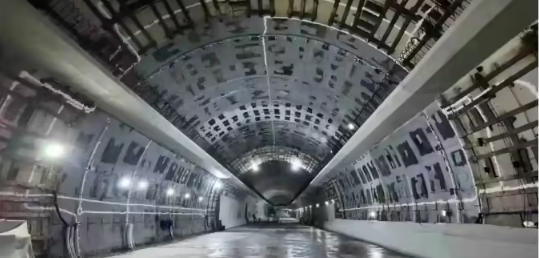
According to the introduction, the shield section of the project tunnel is 4,937 meters long, with a digging diameter of 16.09 meters and a maximum water pressure of 0.82 megapascals. It was the largest-diameter and highest-water-pressure highway shield tunnel under construction in China at that time. Among them, the water pressure at the river bottom connection section is as high as 0.76 megapascals, equivalent to a continuous pressure of about 76,000 kilograms per square meter on the shield shell. The connection section is located in a high-water-pressure and highly-permeable soft soil layer, making it extremely difficult to control the stability of the shield body and the tunnel. The technical difficulty far exceeds the existing tunnel construction technology scope, and it is a highly risky and extremely complex comprehensive project. There are no implementation standards or reference engineering cases at home and abroad.
According to the official press release, China Communications First Highway Group Co., Ltd. has established a precise control network to accurately capture the position and posture of the shield machine in real time. It has independently developed a visualization system for opposite-direction tunneling to collect and present data, comprehensively monitoring the tunneling process and promptly adjusting parameters such as the advancement speed and direction. This has enabled a high-precision connection with a horizontal deviation of 0 millimeters and a vertical deviation of 2 millimeters, far exceeding the design value of 100 millimeters. Further innovations in the asymmetric asynchronous freezing scheme were made, with 363 high-precision drilling and core sampling operations carried out to ensure that the freezing effect met the design standards. With the completion of the excavation, support, and main drive rotation of the connection section, all major risks were eliminated. Finally, on November 29th, the entire "underwater connection section" was completed.
The underwater connection project of the Jiangyin-Jingjiang Yangtze River Tunnel represents the highest level of China's shield machine underground connection technology. From design concept, construction technology to risk control, the project has formed a complete set of technologies for the connection of 16-meter-class shield machines in high-pressure water and highly permeable sand layers under the riverbed. This technological achievement has broken through the length limit of single shield machine's continuous excavation, making long-distance shield tunnels possible. It has significant advantages in terms of cost, construction period, construction organization, risk control, and environmental protection. It provides a replicable and scalable model for the construction of cross-river and cross-sea tunnels in complex geological conditions for the industry. It has reserved key technological achievements and practical experience for promoting the development of deep, large-section, and long-distance shield tunnel technology at home and abroad, as well as for the future planning and construction of super cross-river and cross-sea projects.
The Jiangyin-Jingjiang Yangtze River Tunnel is one of the key projects of the comprehensive three-dimensional transportation corridor in the Yangtze River Economic Belt planned by the State Council. Once completed, it will effectively enhance the capacity of the Yangtze River trunk line's cross-river passage.
 小任班长的博客